Your Website Is Burning Carbon and You Probably Haven't Noticed
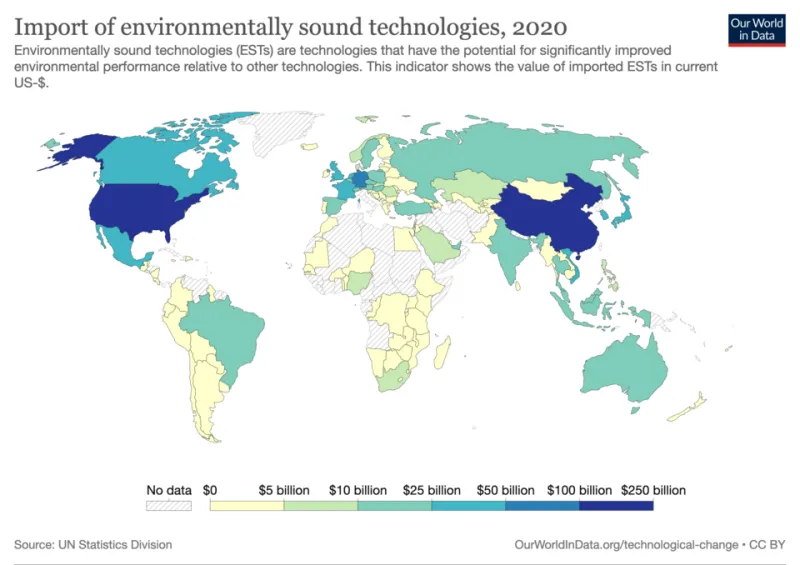
Photo: Our World in Data, CC BY 4.0, via Wikimedia Commons
There's a version of this conversation where we talk about data centres, global internet infrastructure, and the projected carbon output of the digital economy by 2030. It's a genuinely alarming conversation. But let's start somewhere more immediate: your website.
Every time someone loads a page on your site, energy gets consumed. Servers spin up, data travels down cables, browsers render code, and somewhere along the line, electricity gets burned. For a single visit, the impact is negligible. Scale that across thousands of monthly visitors — or, for the bigger SMEs reading this, tens of thousands — and the numbers start to look a lot less comfortable.
According to the Website Carbon Calculator (a free tool worth bookmarking), the average web page produces around 0.5 grams of CO₂ per page view. That sounds trivial until you do the maths. A modest business site with 10,000 monthly visits is generating roughly 60kg of CO₂ per year just from people looking at your homepage. Now think about every other page, every repeated visit, every image that loads twice the size it needs to be.
This isn't a guilt trip. It's a practical observation: the things that make websites carbon-heavy are almost always the same things that make them slow, expensive to run, and frustrating to use.
The Usual Suspects
If you've read anything on WebDorking before, you'll know we have a mild obsession with performance. And it turns out that performance and sustainability are two sides of the same coin.
Unoptimised images are probably the single biggest culprit. A hero image uploaded straight from a DSLR camera can weigh in at 6 or 7 megabytes. Properly compressed and served in a modern format like WebP, that same image might be 200 kilobytes. That's a 97% reduction in data transferred — which means 97% less energy consumed in the delivery of that one asset, every single time it loads.
Then there are third-party scripts. Chat widgets, analytics platforms, social media embeds, cookie consent tools, retargeting pixels — many business websites are hauling in a dozen or more external scripts on every page load. Each one adds latency, each one consumes energy, and quite a few of them are doing almost nothing useful. A proper audit of what's actually running on your site often reveals scripts from tools you stopped using two years ago, still firing on every visit like a forgotten direct debit.
Bloated frameworks are another conversation worth having. There's a tendency in web development to reach for large JavaScript frameworks when simpler solutions would do the job just fine. Not every marketing website needs to be a single-page application. Sometimes a well-structured, lightly scripted static site does the job better — faster, cheaper to host, and considerably kinder to the environment.
Why This Is Starting to Matter Commercially
For a while, sustainable web design was the kind of thing that got discussed at niche conferences and mentioned in agency blog posts that nobody read. That's changing.
Consumer attitudes in the UK are shifting. Younger audiences in particular are paying closer attention to the environmental credentials of the businesses they buy from — and while your website's carbon output might not be the first thing they Google, brand perception is built from dozens of small signals. A fast, clean, well-crafted website communicates competence and care. A slow, bloated one communicates the opposite, regardless of what your sustainability policy page says.
There's also a procurement angle that's becoming increasingly relevant for B2B businesses. Larger organisations — particularly those in the public sector or with their own ESG commitments — are starting to ask suppliers about their environmental practices. Digital infrastructure is part of that picture. It's not mainstream yet, but the direction of travel is clear.
And then there's the hosting question. Green hosting providers — those running on renewable energy or purchasing verified carbon offsets — are more widely available than ever, and in many cases no more expensive than conventional alternatives. Switching is often a straightforward decision once someone actually raises it.
What a Leaner Website Actually Looks Like
Sustainable web design isn't about stripping everything back to plain HTML and removing all the visual craft. It's about intentionality — making deliberate choices about what a site actually needs to do its job.
That means serving images at the right size for the device requesting them, not just shrinking a desktop image down with CSS. It means loading scripts asynchronously where possible, and auditing third-party tools regularly to remove anything that's no longer earning its place. It means choosing a hosting environment that's powered by renewable energy, which in 2024 is a decision that takes about ten minutes to make.
It also means writing leaner code. Not every transition needs a JavaScript library. Not every layout needs a full CSS framework. There's genuine craft in building something that does exactly what it needs to do and nothing more — and that craft tends to produce websites that are faster, cheaper to maintain, and measurably less carbon-intensive.
The Website Carbon Calculator we mentioned earlier gives every site a grade, a per-visit carbon estimate, and a comparison against the broader web. Running your own site through it is a useful reality check. Most business websites that haven't been actively optimised will come back in the bottom half of the distribution. That's not a disaster — it's just a starting point.
The Competitive Angle Nobody's Talking About Yet
Here's the thing about sustainable web practices: most of your competitors aren't doing them. Not because they don't care, but because nobody's asked them to think about it.
That creates an opportunity. A greener website is also a faster website. A faster website converts better, ranks better in search, and costs less to host at scale. The environmental benefits and the commercial benefits point in exactly the same direction — which is a fairly unusual situation, and one worth taking advantage of.
Surrey is home to a lot of businesses that take their brand reputation seriously. Many of them have made genuine commitments to sustainability in their operations, their supply chains, and their offices. It would be a shame if their websites — often the first thing a customer sees — quietly undermined all of that.
The invisible audit isn't complicated. It just requires someone to actually look. And once you've looked, the fixes are usually less dramatic than you'd expect — a round of image optimisation here, a script audit there, a hosting migration that takes an afternoon. The result is a website that's lighter, faster, cheaper to run, and a little easier to feel good about.
That seems worth the effort.