Bespoke Isn't Always Better: The Hidden Price of Chasing Custom When Off-the-Shelf Will Do
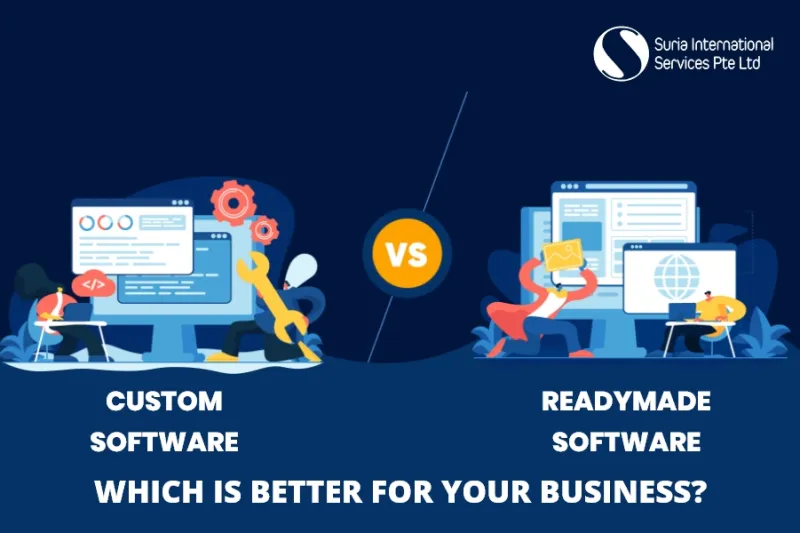
Photo: custom bespoke development vs ready-made software business decision, via www.suriainternational.com
There's something deeply appealing about the word bespoke. It conjures images of Savile Row tailoring — something made precisely to your measurements, crafted with care, utterly unique. In web development, the same word carries the same romance. And it carries a very similar price tag.
The problem is that a hand-stitched suit is a luxury purchase. A hand-coded booking system that does roughly the same thing as Calendly might just be a very expensive mistake.
We've worked with enough Surrey businesses over the years to recognise a familiar pattern. A client comes in with a list of requirements. Most of them are standard. But somewhere in the middle is a feature described with genuine conviction as something their business absolutely cannot do without — something that, as far as they're concerned, doesn't exist anywhere else. And nine times out of ten, it does exist. It's just that nobody's shown them where to find it.
The Psychology Behind 'We Need Something Special'
Before we get into the practical side of this, it's worth understanding why businesses fall into this trap — because it's not stupidity or arrogance. It usually comes from one of a few very human places.
First, there's the competitive instinct. Business owners want to stand out. They've watched their industry long enough to know what their competitors' websites look like, and they want something different. That's a healthy impulse. But 'different' doesn't have to mean 'entirely hand-built from scratch.'
Second, there's the internal process problem. A lot of bespoke requests are really attempts to replicate an existing internal workflow in digital form — often a workflow that isn't particularly efficient to begin with. Rather than adapting to better tools, the instinct is to build something that fits the old way of doing things. That's understandable, but it's a bit like commissioning a custom-built car because you don't want to change your driving habits.
Third — and this one's worth sitting with — there's status. A bespoke website feels like a bigger investment in your business. It signals seriousness. Telling people 'we had it custom built' sounds more impressive than 'we're using a well-configured plugin.' Even if the plugin does the job better.
What Bespoke Development Actually Costs
Let's be direct about the numbers, because this is where the romance tends to fade quickly.
A custom-built feature — say, a client portal, a product configurator, or a custom quoting tool — might cost anywhere from £3,000 to £20,000 depending on complexity. That's the build cost. What often gets glossed over is everything that comes after.
Custom code needs maintaining. Every time WordPress updates, every time PHP moves to a new version, every time your hosting environment changes — someone needs to check that your bespoke feature still works. If the developer who built it has moved on (and they often do), you're paying another developer to reverse-engineer someone else's decisions. That's not a hypothetical. It's a Tuesday afternoon in a lot of agencies.
Off-the-shelf solutions, by contrast, have their maintenance costs baked into subscription fees. The team behind Gravity Forms, for instance, updates their plugin regularly. You're effectively crowd-funding the maintenance across thousands of users. That's a genuinely good deal.
A Practical Framework for Telling the Difference
So how do you know whether your requirement is genuinely bespoke or whether you're about to spend £8,000 on something that a £15-a-month plugin already handles?
Here's a rough framework we use before scoping any development work:
1. Can you describe the outcome, not the mechanism? If you find yourself saying 'I want a button that does X when Y happens,' that's a mechanism. Try instead to describe the business outcome: 'I need customers to be able to book appointments without calling us.' That outcome probably has ten existing solutions. The mechanism might have none — but that's because you invented the mechanism, not because the problem is unsolvable.
2. Does anyone else in your industry have this problem? If you run a letting agency, a dental practice, or a garden centre, thousands of businesses face the same operational challenges you do. The software market has noticed. There are almost certainly tools built specifically for your sector. The question isn't whether a solution exists — it's whether you've looked hard enough.
3. What happens when this feature breaks at 11pm on a Friday? This is the question that focuses the mind. Custom code breaks in custom ways. Off-the-shelf tools have support teams, documentation, and communities of users who've probably already encountered your problem. If your bespoke feature goes down before a big weekend, who are you calling?
4. Is this a permanent need or a transitional one? Sometimes businesses want custom functionality to bridge a gap while they migrate to a better system. That's legitimate — but it should be scoped and costed as a temporary solution, not a permanent investment. We've seen clients spend more on a stopgap than they would have on just fixing the underlying problem.
When Bespoke Really Is the Right Answer
None of this is an argument against custom development. Sometimes it's exactly the right call.
If your business has a genuinely novel process — something that's part of your competitive advantage, something that can't be replicated with existing tools without significant compromise — then bespoke makes sense. We've built custom systems for clients in logistics, professional services, and specialist retail where the functionality genuinely didn't exist anywhere else. Those projects were worth every penny because the feature was core to how the business worked.
The key distinction is this: bespoke development should solve a problem that the market hasn't solved yet. It shouldn't recreate a solution the market solved years ago, just because you haven't found it.
A Word to Surrey Business Owners Specifically
Dorking and the wider Surrey area is home to a genuinely diverse business community — from agricultural suppliers to tech consultancies, from boutique hospitality to professional practices. What we've noticed is that many of these businesses are sophisticated enough to know what they want, but haven't always had a development partner willing to push back when 'what they want' isn't what they need.
A good agency should tell you when off-the-shelf is the smarter choice. Not because they can't build something custom, but because they're thinking about your long-term interests rather than their short-term invoice.
If your current agency has never once suggested a plugin, a SaaS tool, or an existing platform as the answer to your problem — that's worth thinking about.
The Bottom Line
Bespoke has its place. But it's a tool, not a default. The businesses that get the most from their digital investment are the ones willing to be pragmatic — to ask 'does this already exist?' before asking 'can you build this for us?'
Sometimes the answer is genuinely no. But more often than not, the answer is yes, it exists, it's well-supported, and it'll cost you a fraction of what a custom build would. That's not settling for second best. That's just good digital craft.